



The expanding complexity of rental operations has encouraged owners and operators to evaluate solutions that streamline processes, enhance oversight, and deliver accurate financial insights. As organizations examine various tools, understanding technical, functional, and strategic differences becomes essential for selecting the most appropriate system. Many stakeholders explore options related to property management software development to achieve systems tailored to their operational realities. A disciplined approach to comparison enables informed decision-making, stronger scalability, and improved long-term asset performance.
Evaluating Modern Platforms for Diverse Rental Portfolio Needs
Selecting the right platform begins with a comprehensive review of management requirements across different property types. Residential portfolios may prioritize communication workflows, while commercial assets often demand advanced financial modeling. Mixed-use portfolios require flexible configurations that can reconcile differing occupancy patterns, billing rules, and compliance obligations.
Comparative evaluation typically considers four influential areas:
- Operational complexity across asset classes
- Required automation depth for recurring processes
- Reporting and analytics demands
- Support for regulatory and financial compliance
Although ready-made platforms address common workflows, organizations with unique operating models often explore property management software development to configure functionality around their specific performance goals. Clear requirement mapping ensures that any chosen or custom-built system aligns with immediate needs while remaining adaptable to future expansions.
Key Functional Categories Found Across Leading Platform Options
Most platforms are built around a shared functional core, but the breadth and maturity of specific capabilities vary significantly. Understanding these functional categories allows decision-makers to compare solutions more accurately.
Key areas of differentiation include:
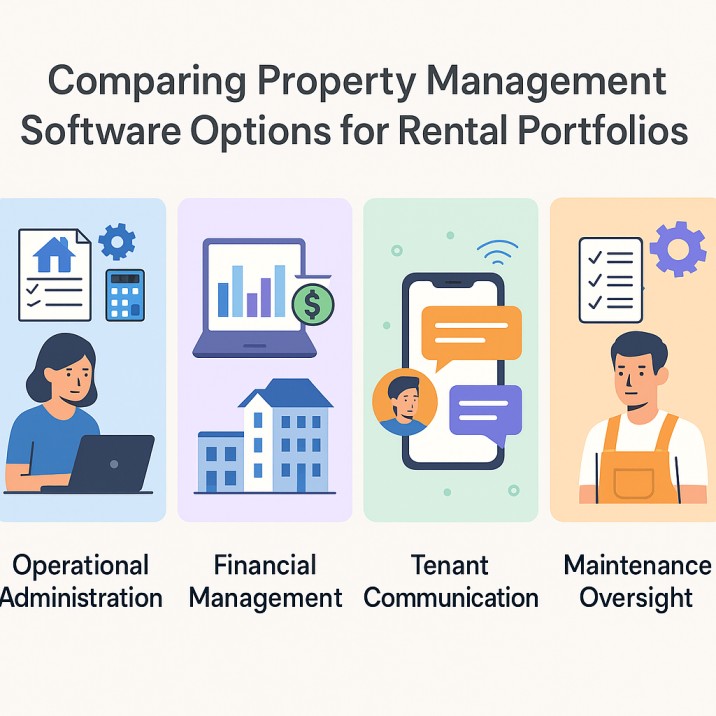
- Operational Administration: Tools for lease management, rent calculation, maintenance scheduling, and vacancy tracking.
- Financial Management: Ledger structures, billing workflows, expense tracking, and audit-ready reporting.
- Communication and Collaboration: Channels for tenant–landlord correspondence, notifications, and document sharing.
- Maintenance Oversight: Work order creation, vendor coordination, and lifecycle tracking of repairs.
- Analytics and Performance Measurement: Dashboards that support performance reviews, forecasting models, and operational benchmarking.
- Workflow Automation: Capabilities that reduce manual intervention and ensure adherence to process standards.
When organizations undertake tenant management software development, many of the above functional areas are extended to support high-volume communication, incident handling, and automated responses. This helps ensure consistency and transparency in tenant engagements across distributed portfolios.
Assessing Integration Capabilities Within Complex Rental Ecosystems
A key differentiator among available platforms is the ability to integrate smoothly with existing systems. Most rental organizations operate a diverse ecosystem of financial, operational, and customer-facing technologies. A management platform that cannot exchange data effectively risks creating operational silos and duplicative work.
Core integration considerations include:
- Compatibility with accounting solutions and enterprise financial systems
- Data exchange capabilities with customer service, access control, and IoT monitoring tools
- Support for API-driven connectivity
- Data governance rules governing synchronization frequency and accuracy
- Vendor policies for ongoing system updates and API stability
Organizations pursuing property management software development often prioritize flexible integration patterns to eliminate data fragmentation. When executed effectively, integration ensures consistent information flows, reduces reconciliation workloads, and enables advanced analytics derived from a unified data environment.
Comparing User Experience Factors Across Management Solutions
User experience directly influences adoption, productivity, and error reduction. Even feature-rich systems can underperform if interfaces are difficult to navigate or require excessive training. A systematic comparison of usability is therefore essential.
Important evaluation areas include:
- Dashboard clarity and customization options
- Accessibility across mobile devices and web browsers
- Workflow intuitiveness for daily operational tasks
- Flexibility of navigation controls and search functions
- Learning curve for new staff and service providers
- Availability of help resources, tutorials, and guided workflows
Organizations seeking to develop property management app capabilities often focus heavily on user experience design. Field personnel, administrative teams, and tenants all benefit from interfaces that reduce redundant steps and highlight priority tasks. Testing prototypes with real users often yields insights that significantly improve the final product’s usability.
Analyzing Scalability and Performance for Growing Property Portfolios
Solutions must scale efficiently as portfolios expand in unit count, geographic footprint, and operational complexity. Performance degradation can affect financial accuracy, responsiveness, and tenant satisfaction. Scalable platforms typically demonstrate:
- Stable performance during peak transaction periods
- Capacity to handle large datasets without latency
- Efficient handling of multi-regional operations, including localized compliance settings
- Expandable module structures that support new asset classes
Cloud-native architectures often outperform legacy on-premise systems in scalability because updates, resource allocation, and load balancing are centrally managed. When organizations build their own platforms through property management software development, they typically design modular architectures that allow feature sets to grow without causing disruptions to existing workflows. This is particularly critical for organizations anticipating mergers, acquisitions, or large construction pipelines.
Security Expectations Required in Contemporary Management Platforms
Modern rental operations involve high-risk data domains, including personal tenant information, financial details, lease agreements, and vendor contracts. Security practices must therefore be a central factor in the evaluation process. Failure to meet security obligations can lead to regulatory penalties and erosion of stakeholder trust.
Common security requirements include:
- Role-based access controls to ensure least-privilege permissions
- Data encryption during transmission and at rest
- Multi-factor authentication for administrative users
- Secure audit logs for tracking system activity
- Data retention and deletion rules aligned with regional standards
- Regular vulnerability assessments and penetration testing
Custom projects, including efforts related to property management software development cost analysis, must incorporate long-term security considerations into planning. Security frameworks should be designed in parallel with business logic to prevent expensive retrofitting after deployment.
Budget Considerations When Selecting Optimal Software Architectures
Budget evaluation extends beyond base licensing fees. Total cost of ownership includes implementation, configuration, training, integration, and maintenance. Understanding these cost categories helps organizations compare solutions on a long-term financial basis.
Important budget considerations include:
- Subscription or licensing structure
- Costs associated with data migration from legacy systems
- Fees for advanced modules, premium features, or reporting add-ons
- Training and onboarding requirements for internal teams
- Maintenance contracts and support tiers
- Resource allocations for internal IT teams
- Long-term scalability requirements that may influence hosting fees
Organizations planning to calculate property management software development cost should consider architectural decisions, coding frameworks, integration patterns, security expectations, and ongoing operational overhead. A realistic budget plan aligns technology investments with organizational growth strategies.
Strategic Roadmapping for Long-Term Technology Adoption Decisions
Beyond immediate functional needs, long-term planning must consider how a solution fits into evolving operational models. The technology selected today should support tomorrow’s innovations. Strategic roadmapping helps align platform choice with broader business objectives.
Strategic planning should examine:
- Anticipated changes in regulatory environments
- The role of automation and artificial intelligence in future workflows
- Data maturity goals and the organization’s capacity for advanced analytics
- Workforce evolution and expected shifts in user roles
- Opportunities to enhance tenant experiences through digital touchpoints
- The feasibility of adding new modules or integrations over time
Organizations that choose to develop property management app capabilities often adopt multi-year roadmaps to ensure systematic enhancement of their platforms. Aligning technology priorities with organizational objectives strengthens resilience and creates a more cohesive digital ecosystem.
Conclusion
Comparing software platforms for rental management requires systematic evaluation of functionality, scalability, usability, integration, security, and long-term architectural suitability. A structured assessment framework ensures that selected solutions align with operational needs across diverse property types and portfolio sizes. By examining each platform’s strengths and limitations through a comprehensive lens, organizations are better positioned to make investment decisions that support accuracy, efficiency, and strategic growth over time.










Leave a comment